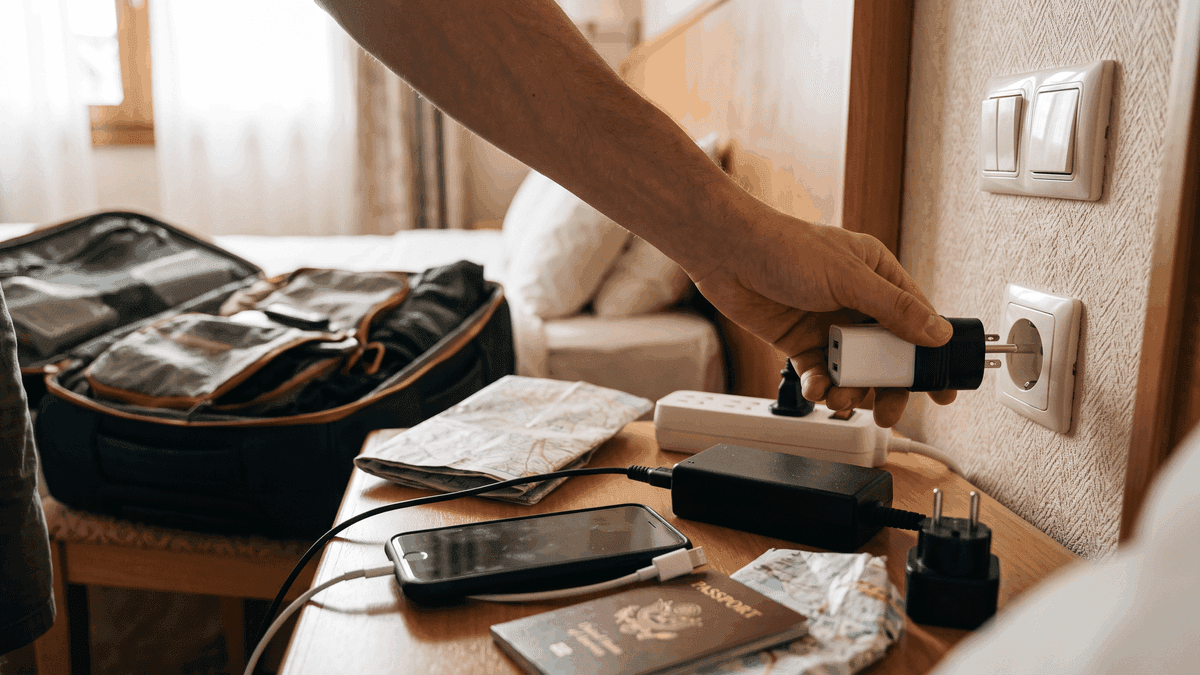
Melting a $200 hair straightener into a smoking lump of plastic inside a boutique Parisian Airbnb is a rite of passage no digital nomad wants to pay for. Most of the world uses 220–240V mains power and different plug types, while the US, Canada, Mexico, and Japan stubbornly stick to 100–127V with Type A/B plugs. If you bring your favorite domestic gadgets across international borders without checking the fine print, you are playing a very expensive game of electrical roulette. Let's look at how to keep your gear powered up without blowing up the local substation.
The Voltage Reality Check: 110V vs. 220V
The fundamental conflict of global travel is that wall sockets outside North America run at double the electrical pressure. Devices designed only for 100/120V power can be destroyed if plugged directly into 220/240V electricity without a proper voltage converter or transformer. Your hardware doesn't care about your jet lag—it only cares about physics.
Before you jam any plug into a foreign wall, grab the charging brick and squint at the tiny printed text. If it says "Input: 100-240V, 50/60Hz," you are holding a dual-voltage device that will happily adjust to foreign currents. If it says "120V only," step away from the outlet.
Voltage Checking Rules
- Check the small print on every single charging brick before departure.
- North American systems operate on a lower voltage standard (100–127V).
- Much of the globe relies on the heavier 220–240V standard.
- Ignorance of voltage differences is the leading cause of fried electronics abroad.
The Great Adapter vs. Converter Misconception
Travelers constantly confuse adapters and converters, and that confusion usually costs a few hundred bucks in fried gear. An adapter simply changes the physical shape of the metal prongs so it fits into a foreign wall socket. It does nothing to change the actual electricity flowing through the wires.
Many modern electronics are built for a wide input range of about 100–240V and only need a plug adapter, not a voltage converter, when used abroad. You plug your MacBook charger into a cheap plastic cube, slide it into the wall, and you're good. Heating appliances are an entirely different beast.
Adapter and Converter Facts
- Plug adapters alter physical geometry, not electrical output.
- Voltage converters actively step down 240V to 120V for sensitive appliances.
- Using an adapter alone on a single-voltage appliance triggers immediate thermal overload.
- Always verify your appliance specs before packing them into your carry-on.
Heating Appliances and Other Death Traps
Heating appliances like hair dryers, straighteners, and irons are typically single-voltage (110V-120V in the US) and will burn out or pose a fire hazard when plugged directly into a 220V-240V outlet abroad without a proper transformer. The heating elements inside these devices draw massive amounts of current.
When you force 240 volts through a 120-volt heating coil designed for US resistance, it gets four times hotter than intended—instantly. The heating element vaporizes, sparks fly, and your hotel room smells like scorched copper.
Hair and Beauty Gear Rules
- Travel hair dryers and dual-voltage curling irons save you from conversion headaches.
- Heavy-duty voltage transformers are heavy, expensive, and generally not worth packing.
- Leave your standard domestic bathroom appliances at home.
- Buy cheap local alternatives at your destination if styling tools are non-negotiable.
Navigating the 15 Global Plug Types
It would be too easy if the world agreed on a single electrical shape. Electrical plugs and sockets vary across 15 different types globally (designated A through O), with Type C (Europlug) being the most widely used across continental Europe.
Carrying a universal all-in-one adapter is standard operating procedure for any seasoned nomad. Avoid buying cheap gas-station knockoffs that snap inside the wall.
Global Plug Standards Comparison
| Region | Standard Voltage | Common Plug Types | Converter Needed for US Dual-Voltage? |
|---|---|---|---|
| North America | 120V | Type A, B | No |
| Continental Europe | 230V | Type C, E, F | No (Adapter only) |
| United Kingdom | 230V | Type G | No (Adapter only) |
| Australia / NZ | 230V | Type I | No (Adapter only) |
| Japan | 100V | Type A, B | No |
Plug Types Explained
- Type A and B dominate the Americas and Japan.
- Type C (Europlug) handles continental European charging duties.
- Type G (the chunky three-prong British beast) rules the UK, Ireland, and Singapore.
- Type I covers Australia, New Zealand, Argentina, and China.
Surviving 220V Life With Your Tech Intact
Most modern smartphone, laptop, and camera chargers are dual-voltage (rated for 100V-240V), meaning they do not require a heavy step-down voltage converter abroad. Your digital nomad workflow is remarkably resilient to foreign juice as long as you stick to USB-powered gear and modern laptops.
Invest in a reliable multi-port GaN charger with interchangeable regional slides. It eliminates the clutter of carrying five separate bricks and ensures your mobile office stays juiced from Bali to Berlin.
Nomad Power Setup
- Dual-voltage laptop chargers handle international travel without missing a beat.
- USB-C power delivery standards make universal charging simpler than ever.
- Invest in a high-quality surge-protected universal adapter.
- Pack a compact power strip if you are working from cafes with limited wall access.
Bottom Line
- Check the input voltage rating on every single device before plugging it into a foreign wall.
- Leave high-wattage heating appliances like hair dryers at home to prevent electrical fires.
- Remember that adapters only change plug shapes; they do not convert voltage.
- Rely on dual-voltage tech for seamless geoarbitrage.
FAQ
Will plugging my US phone charger into a European outlet blow it up?
No, because almost all modern smartphone chargers are dual-voltage (100V-240V). You only need a cheap physical plug adapter.
Do I need a voltage converter for my MacBook?
No. Apple power bricks automatically adjust to local voltages anywhere in the world. Just snap on the right plug duckhead or use an adapter.
Can I buy a cheap hair dryer abroad instead of a converter?
Yes, and you should. Buying a local 220V hair dryer at a department store upon arrival is cheaper and safer than hauling a heavy transformer.
Sources
- REI Travel Power Adapter Guide
- USA Today 10Best Europe Power Guide
- International Trade Administration Electricity Data
- AAA Power Abroad Guide
- Electrical Safety First Traveller Tips
- WorldStandards Electricity Guide