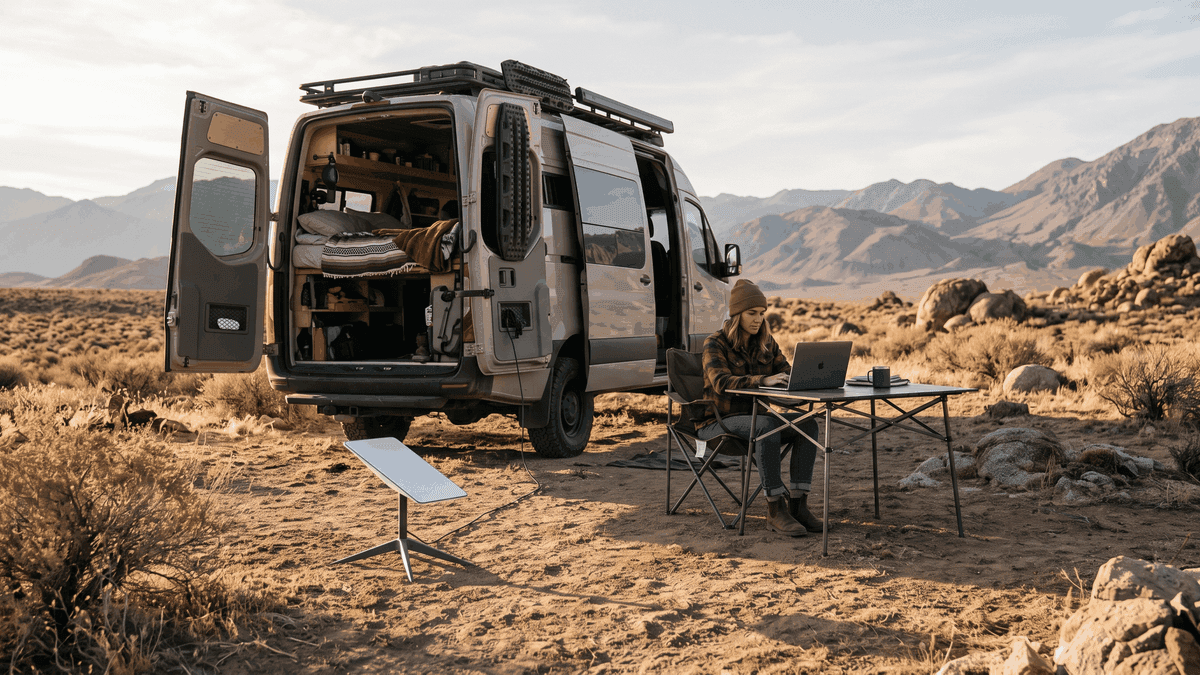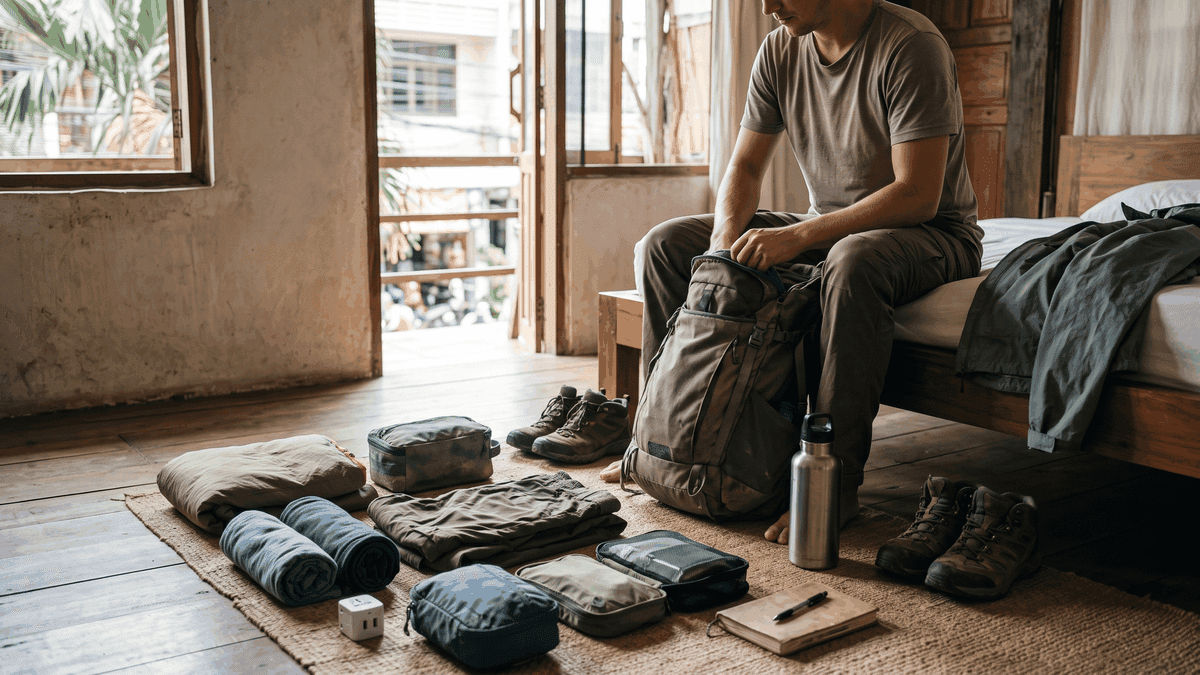
If checked-bag fees land on every flight of a twelve-month trip, you aren't an adventurous nomad — you're a luggage ATM for budget airlines. Ryanair charges €70–75 at the gate for an oversize carry-on alone, Wizz Air is known to do the same, and the arithmetic gets ugly after a dozen flights. The gear you strap to your back is the difference between a clean, cheap year on the road and a slow bleed of fees and stress. The taxman won't help you replace blown zippers, and the airline won't care when your bag fails its sizer.
Smart geoarbitrage starts with that kit: typical weights and prices as of October 2026, the airline rules you actually need to respect, and the repair habits that keep a pack alive for years.
TL;DR
- Rightsize your pack: Choose a compression-style pack under 40L to avoid airline gate fees, keeping in mind that strict carriers charge extra for overhead bags.
- Invest in merino wool: High-performance merino tops let you go days between washes, saving significant coin-laundry costs over a full year on the road.
- Protect your tech and documents: Pack a modern GaN fast charger with universal voltage support and keep your backups secure in an RFID-blocking organizer. Always secure international health insurance claims abroad documentation digitally before changing locations.
- Pack a field repair kit: A tiny pouch with gear tape, a needle, upholstery thread, and spare buckles saves broken gear from the landfill.
Packs and Organization Essentials
Compression-Style Travel Backpack
Start here, but treat every spec with suspicion. A compression-style pack under 40L helps you dodge checked-bag fees (as of 2026) — but only when the airline's allowance accepts that size. Ryanair's free allowance is a small under-seat bag (up to 40×30×20 cm); an overhead-bin bag (up to 55×40×20 cm, max 10 kg) requires the paid "Priority & 2 Cabin Bags" product. Wizz Air is the same shape: free 40×30×20 cm under the seat, with the 55×40×23 cm cabin bag reserved for WIZZ Priority. On full-service carriers, most 40–45L packs fit a free 55–56 cm cabin allowance.
- Capacity matched to your most restrictive carrier's allowance
- Internal compression straps to lock down bulky garments
- Hidden passport pockets to deter opportunistic terminal thieves
- An abrasion-resistant shell — most carry-on packs use 500D–1000D nylon (800D-class is common)
For tested models, Wirecutter's travel-backpack guide is the reference: its top pick splits into a 40L carry-on main pack plus a detachable daypack — exactly the shape of kit that survives a year.
Modular Packing Cubes
Packing cubes are the only reason your underwear won't mingle with your dirty laundry by month three: they partition your life into modular blocks so you never dump the whole pack onto a hostel floor for socks. Wirecutter has tested 36 cube models across eight years; its current all-around winner is a three-cube set for about $59.
- Mesh tops for instant visual ID of contents
- Ultra-light ripstop fabric that adds zero dead weight
- Compression zippers to squeeze out every last cubic millimeter
Packable Daypack
The item you'll touch more than any other: market runs, hikes, museum days, and the bag that stays at hostel reception while the main pack is locked away. It packs to the size of a grapefruit.
- Packs into its own integrated pocket
- Around 250–400 g when empty, with sternum and lightly padded straps for load days
Compression Stuff Sacks and a Laundry Sack
One-way air valves squeeze winter bulk out of puffy layers and sleepwear. A single bright laundry sack keeps dirty clothes sealed in one place — clean cubes stay clean, and hostel laundry day takes one trip, not three.
- One-way air-valve design that squishes bulk out
- Coated nylon shells that keep smells in the sack
RFID-Blocking Document Organizer
Your passport, backup credit cards, and recovery phrases are your lifeline abroad, and transit hubs are where they get lifted. A water-resistant, RFID-shielded organizer blocks contactless skimming and forces you to count documents on every move.
- Dedicated slots for four cards and a passport booklet
- Water-resistant zip closure and a slim profile for a front pants pocket
Typical weights and prices (October 2026)
Typical 2026 ranges from current retail listings (models vary by brand and season): 40L travel packs run 1.2–1.8 kg and $120–$250, three-cube sets 200–350 g and $30–$60, merino tees 120–200 g and $60–$100, and 65–100W GaN chargers 100–200 g and $35–$70.
Power Up Without Burning Down Your Hostel
Gallium Nitride Fast Charger
A multi-voltage, gallium-nitride (GaN) fast charger reduces the need for region-specific adapters and protects sensitive digital-nomad tech abroad (as of 2026). GaN is now the default semiconductor for quality chargers: current models convert power at roughly 93–95% efficiency, which is why 100W units stay small and cool where old silicon bricks burned your hand. One 65–100W unit with USB-C Power Delivery runs a laptop, phone, and tablet from a single outlet.
- Universal 100–240V input for seamless global voltage shifts
- Interchangeable regional plug pins included in the chassis
- Multiple USB-C PD ports to run your entire digital office
Universal Travel Adapter with Fuses
Wall sockets across the globe are a hazard zone for expensive electronics. A grounded adapter with a replaceable fuse ensures a rogue surge in a 1970s Spanish apartment costs you a 50-cent fuse, not a laptop motherboard. Prefer sliding prongs over an all-in-one brick that sags out of loose sockets.
- Sliding prongs for UK, EU, US, and AU outlets
- Spare glass fuse tucked inside the casing
- Compact footprint that sits snug in loose wall sockets
Apparel That Survives a Week Without a Wash
Merino Wool Travel Clothing
Merino lets most people go three to seven days between washes: Wirecutter's own test left one merino tee almost stink-free after six days. The fiber draws moisture into its core, making it less hospitable to odor-causing bacteria than cotton or polyester. Expect variance — plan around three days and treat a week as a pleasant surprise.
- Naturally antimicrobial fibers that neutralize body odor naturally
- Temperature-regulating weave that breathes in Bali and insulates in Berlin
- Fast-drying blends for rapid sink-washing sessions
At $60–$100 a tee it hurts, until you price the alternative: €15 a week on coin-laundry machines (about $17 at current rates) is roughly $800 a year. REI's merino explainer covers the fiber science; Wirecutter's merino tee test has the realistic freshness numbers. If you need to keep your gear connected while evaluating mobile carriers or managing connectivity across hubs, understanding tools like portable wifi vs esim vs local sim ensures you stay online without carrying excess weight.
Packable Rain Shell
Weather forecasts in foreign cities are suggestions at best. A featherlight waterproof shell keeps your tech dry when a tropical downpour turns a walking tour into a swimming lesson — and doubles as a windbreaker on planes and ferries.
- Fully taped seams to prevent seepage during heavy squalls
- Pit zips for heat dumping during steep urban hikes
- DWR coating, renewable with a $10 spray when it wets out
Durability Field Notes: What Actually Dies on the Road
Gear fails in a predictable order — almost none of it is the main fabric:
- Zippers — cheap coil zips on pack bodies and cubes fail first, usually from sand and taxi-boot compression.
- Mesh pockets — stretch mesh snags and tears on hostel bed frames and baggage carousels.
- Webbing and buckles — straps abrade where they slide through buckles; plastic buckles crack in cold weather.
- Seam tape — DWR coatings delaminate, and taped seams weaken after heavy UV and salt exposure.
All four are field-repairable in ten minutes with the kit below. The Washington Trails Association's mend-before-you-spend guide is the best free rundown of the basics.
Repairability: Assume It Will Break
Buy gear with repairability in mind, not just weight and looks:
- Standard hardware: choose packs with common zipper sizes and standard buckles. Replacement sliders and buckles cost $2–6 and pop on in minutes; proprietary hardware means a $200 mail-in repair.
- Warranties that mean it: several mainstream pack brands — Osprey and Patagonia among them — repair or replace their packs for life.
- Local repair is cheap: tailors and shoe-repair shops fix bags, straps, and zippers for a few dollars in most city hubs; ask the hostel front desk.
- The kit that travels: a roll of tenacious-style gear tape, a needle with upholstery thread, two spare buckles, and two zipper sliders weigh under 100 g.
Buy on Arrival
One rule: buy the high-wear performance items at home — pack, shoes, merino — and buy bulky consumables where you land. Toiletries, detergent sheets, adapters, and cheap flip-flops cost the same or less at a Bangkok 7-Eleven than they do as checked-bag weight. Test the adapter on day one in any new country; don't import the 2L shampoo that pushes your bag past 10 kg; and let the $5 towel be the cheap call — splurge on the pack, shoes, and merino that touch your body daily.
Tech Protection and Miscellaneous Gear
Ultralight Microfiber Towel
Hostel towel rentals add up, and damp cotton towels breed mildew. A technical microfiber towel dries your skin in seconds and air-dries on a backpack strap by the time you reach the train station.
- Silver-ion treatment to prevent bacterial growth and funky smells
- Packs down to the size of a soda can
- Hanging snap-loop for easy drying on bunk bed frames
Field Repair Kit
The 100 g kit from the repairability section in one pouch: tenacious-style gear tape, needle, upholstery thread and a safety pin, two standard buckles, two zipper sliders, and two heavy-duty zip ties — an instant strap repair in a pinch.
Bottom Line
- Audit your loadout: if it weighs more than a kilo and doesn't pull double duty, it stays home.
- Rightsize to your most restrictive airline: under-seat free allowances are around 40×30×20 cm on Ryanair and Wizz Air, where overhead bags cost extra; full-service carriers usually fit a 40L pack free.
- Follow the Wirecutter backpack guide and its packing-cube guide instead of spec-sheet marketing.
FAQ
Do I really need to spend $60+ on a single merino t-shirt?
If you're packing for a year, yes — because you pack three merino tees instead of fourteen cotton ones. Expect roughly three to seven days of freshness per shirt depending on body chemistry; Wirecutter's testing left one merino tee almost stink-free after six days. Every extra cotton tee is weight and a laundry run you pay for.
Will a 40L backpack fit as carry-on on budget carriers like Ryanair?
Usually not for free. Ryanair's allowance without add-ons is a small under-seat bag (up to 40×30×20 cm). A bag for the overhead bin — up to 55×40×20 cm and 10 kg — requires the paid "Priority & 2 Cabin Bags" product, and an oversize carry-on at the gate costs €70–75. Wizz Air works the same way: a free 40×30×20 cm under-seat carry-on, with the 55×40×23 cm cabin bag tied to WIZZ Priority. A soft 40L pack can squeeze into a 55×40×20 sizer if it isn't overstuffed, but "easily slides in without triggering fees" is marketing, not reality.
Are GaN chargers safe to use with older electrical wiring?
Mostly yes, with management. Quality GaN chargers include built-in thermal protection, over-current safeguards, and intelligent power distribution, and current models are efficiency- and heat-tested by independent outlets. But no charger can fix a genuinely dangerous socket: use a fused, grounded adapter, avoid loose or sparking outlets, and don't run high-wattage charging from a frayed extension cord. If the wiring feels suspect, charge in the hostel lobby.
Will carry-on-only actually save me money?
Usually, but run the numbers per itinerary. Ryanair's oversize gate fee runs €70–75, Wizz Air's is reported in the same range, and checked bags are a paid extra on virtually every budget carrier — one gate fee eats a year of adapter upgrades. On fares that bundle a cabin bag, or on full-service airlines with generous limits, the savings shrink, so check the fare before you contort your packing.
Sources
- Wirecutter — The Best Travel Backpack, retrieved October 2026
- Wirecutter — The 4 Best Packing Cubes, retrieved October 2026
- Wirecutter — Are Merino Wool Shirts Really Stink-Resistant?, retrieved October 2026
- REI Co-op — What Is Merino Wool?, retrieved October 2026
- ZDNET — The Best GaN Chargers of 2026, retrieved October 2026
- Ryanair — General Terms & Conditions (Baggage; Article 8 / Regulation 3), retrieved October 2026
- Wizz Air — Baggage Allowance, retrieved October 2026
- KAYAK — Wizz Air Hand Luggage: Everything You Need to Know, retrieved October 2026
- Washington Trails Association — Mend Before You Spend, retrieved October 2026